
In creating an online teaching resource to support graduate teachers for their Year-7 students, I devised some new learning about myself and of God, the higher power, the great man that Jesus was, his sacrifices and my beliefs in God.
My key takeaway is that Catholicism is about the importance of trust, the use of behaviours that go along with trust, the mental attitude geared with trust, and this is supported by the feeling of confidence trust gives you as an individual mentioned by Thagard (2018).
As a religious person, I have learned that I indeed believe in a foundation of spirituality and that of divine power and that catholic tradition and ritual has been a pillar of my religious beliefs always – oftentimes without realising it.
It is my belief that, it is of great importance when teaching Year-7 students’ prayer in Religious Education (RE) to understand faith changes throughout their life as they evolve and specifically through the seven levels of faith development.
The topic of faith is, through believing , trusting, and living out trust through doing and responding to God means to believes in him Miller (2019).
Reflecting taught me valuable lessons about prayer – that Jesus Christ is the centrepiece around which Christian prayer revolves. This of itself gives me a structure which I can use with my Year-7 students and in utilising those processes to plan teaching when and where to pray.
Did Jesus pray in the morning? Yes.
Did he pray in the evening? Yes.
Did he pray by himself? Yes.
Did he pray with others? Yes, he prayed at all times, both alone and with others.
I can take this valuable lesson learned from Jesus. When I pray by following Jesus’ example, I enter into boundless trust which keeps me connected in love, forgiveness and without violence according to Miller (2019).
An impactful learning for me was the 3 different ways to pray. This is an intrinsic part of my faith and I cannot recall if I learned this from my parents, though church or school, but it wasn’t until I sat back and thought about vocal, meditative and contemplative prayer that I actually became aware of how spiritual I was.
Whilst I like to think of myself as a heart and soul kind of person, I do not tend to voice my Prayers out loud. I prefer to focus and direct my attention to God through emotional desire as described by McColman (2015).
I found it important to acknowledge that for myself the most important kind of prayer is contemplative prayer as it gives me the chance to rest quietly in God’s presence – just me and him quietly together.
I reflected on catechism and the sacraments, and that prayer has five different ways of being taught. Most significantly though, and maybe it’s because of the noise in our lives right now, but in a selfish way, I either forgot or did not consciously realise the foundation of my families’ prayers are those of intercession and that’s what being a Christian is all about. That we always prey for everyone, for people close to us and also those not close to us. I think this and the other factors mentioned by Miller (2018) will always resonate with me in some way, as a way of reminding me I’m on the right track and can take my Year-7 students on the journey of prayer and its importance in their lives.
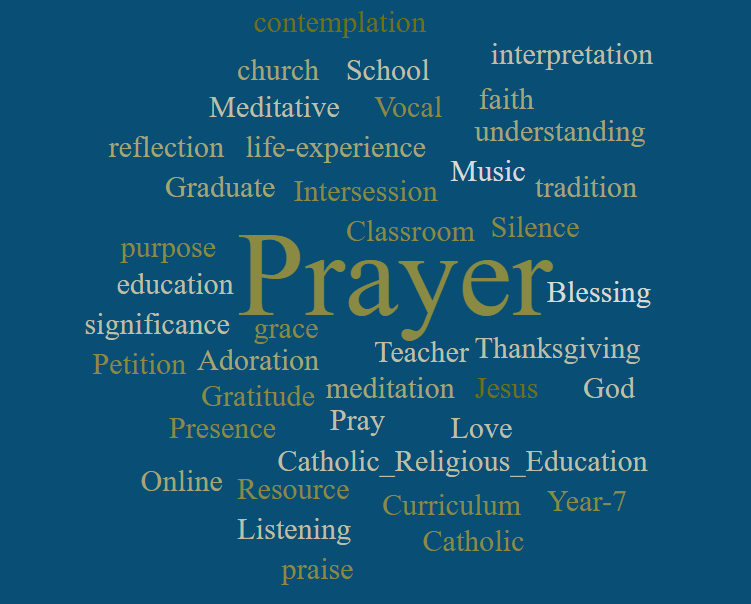
Creating the Website
WordPress – the tool of choice to build my website was for two reasons; the template options available, and in observing the principles of visual design and web content accessibility guidelines. The latter is important to me, being dyslexic myself, alternatives to reading slabs of text is preferred and with the options available to link to online resources including YouTube videos, supports engagement of students who seek these options as modes of learning.
Teaching and Learning Online
As on online student myself and also having witnessed hybrid classes during my teaching placements to date, I’ve realised the online learning space often challenges students from both the physical access and connectivity aspects. For teachers, their focus is on teaching and assessing the prescribed curriculum to gauge engagement and deep understanding. For students, we cannot ignore the diverse learning modes that can ease the pressure fostering positive learning experiences. A good teacher, especially in topics that are not traditionally connected with online content such as prayer, have lots of opportunities to utilise online modes and apps to entice and encourage engagement.
While it can challenge traditional classroom environments, the digital world is unavoidable in teaching, but it’s also a wonderfully rich resource for teachers too and digital fluency in today’s classroom includes more than just teaching to a curriculum. Having attended two schools as a pre-service teacher, I’ve learned it’s about guiding students through learning with technology as a principal tool the learning content associated with the topic (in this case prayer), is part of that.
The Home of Pottz
The Home of Potts is a digital location for the presentation of Assignment 1 in EDS485 Prayer and Morality in Catholic Education in SP1 of 2023.
It’s also a location for use by the members of my family and future employers to check-in occasionally, a place to witness my journey to becoming a teacher, and the steps taken in transitioning from my previous vocation to the education sector in secondary teaching and physical education.
Having previously worked in finance (accounting) and corporate procurement, they will probably say I was always meant to follow this path but did not have the courage.
It took a global pandemic and a being made redundant to help me decide the time was right to seek my vocation of choice.
I’m now 20 subjects into my Bachelor of Education (Secondary) HASS degree at Curtin University via Open Universities Australia. The end is in sight and I’m looking forward to teaching in the Catholic education sector.
The home of Potts – a website by Stephen Potter Curtin ID: 20369875 OUAID:1119967
 The Home of Pottz by Stephen Potter